From dramatic cobalt poppies to serene white lotuses, these floral mosaics show how handcrafted surfaces can transform the atmosphere of a space.
Flowers have always carried more than decorative beauty. In art, they can represent passion, renewal, abundance, serenity, memory, or the fleeting nature of life.
When translated into mosaic, floral imagery gains another dimension. Thousands of individual pieces catch and reflect light differently, giving petals a sense of movement and allowing colors to shift as the viewer crosses the room. What appears painterly from a distance becomes richly tactile up close.
That combination of image, texture, and changing light makes floral mosaic wall art especially powerful in architectural interiors. It does not simply hang on a wall. It becomes part of the wall—and often the emotional center of the entire space.
The following seven works present distinctly different interpretations of flowers in mosaic. Together, they form a visual journey from dramatic color and immersive gardens to poetic memories and serene Eastern symbolism.
1. Golden Nocturne: A Garden Illuminated From Within
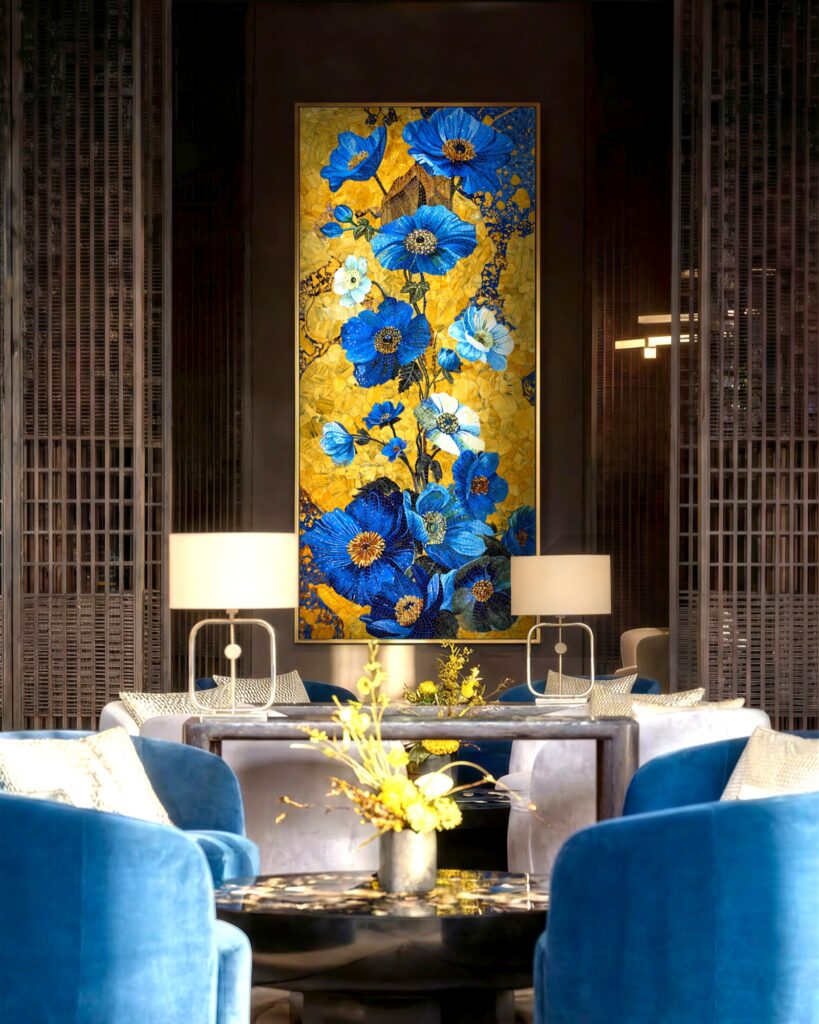
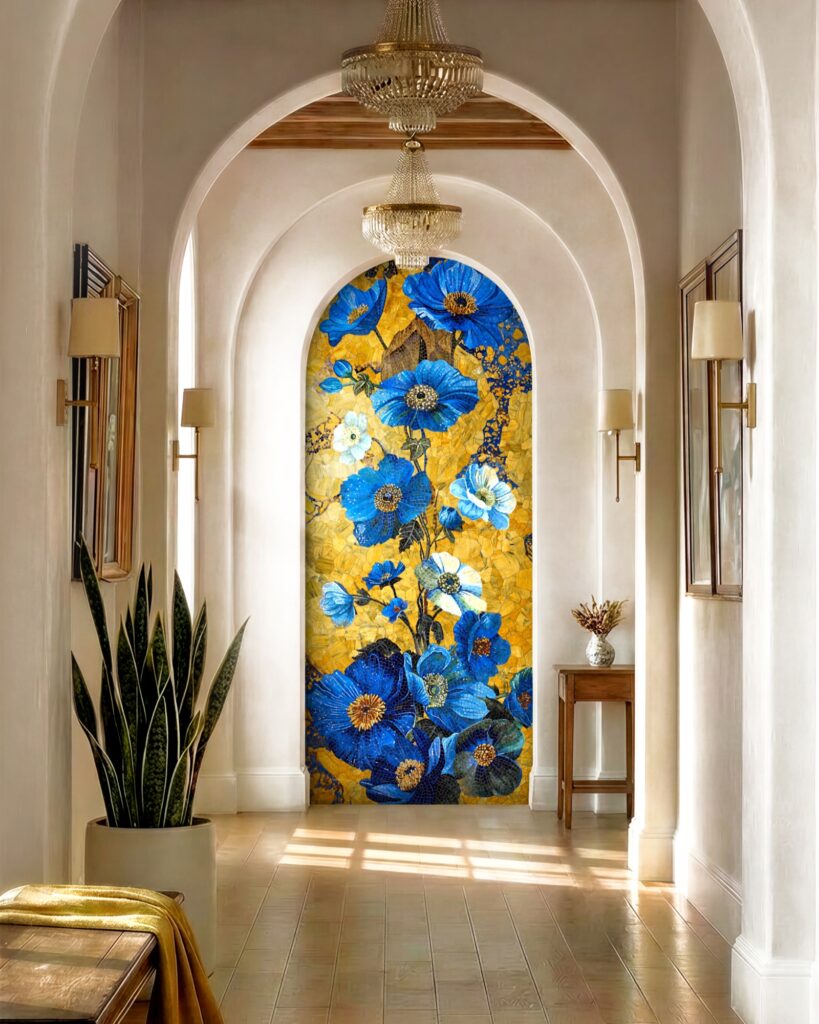
Some floral compositions are designed to soothe. Golden Nocturne does something different: it immediately commands attention.
Large cobalt-blue poppies unfold against a richly textured golden ground. Pale blossoms and almost-black leaves interrupt the dominant color pairing, adding depth while making the blue appear even more intense.
The drama comes from contrast. Blue carries associations of serenity, imagination, and rare beauty, while gold introduces warmth, abundance, and radiance. Together, they evoke a nocturnal garden illuminated by an unseen source of light.
Diagonal movement keeps the composition from feeling formal or static. Instead, the flowers seem to spread across the surface, while variations in scale create a contemporary visual rhythm.
At 1,050 × 2,400 mm, this tall-format artwork is particularly well suited to an entrance, hotel lobby, bar, or luxury commercial interior. It works best where the surrounding architecture is restrained enough to let the blue-and-gold palette become the focal point.
Visual character: Dramatic, luxurious, contemporary
Best suited to: Hotel lobbies, bars, entryways, and statement walls
2. Crimson Bloom: Floral Beauty at Its Most Intense
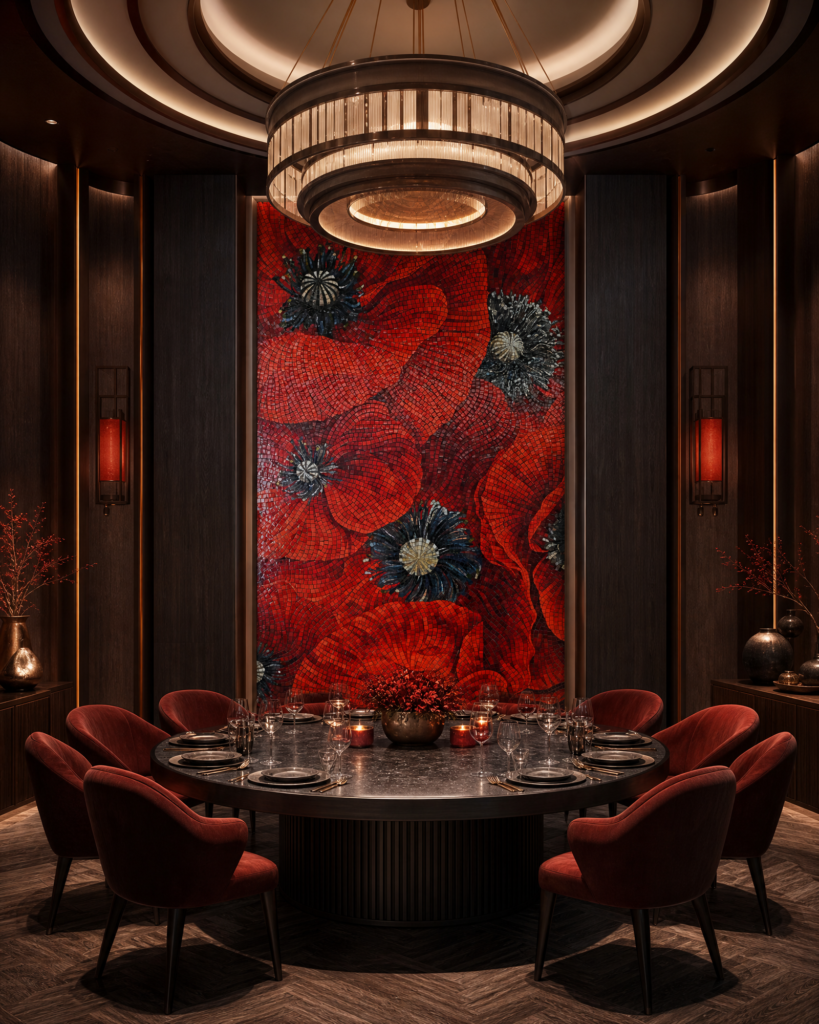
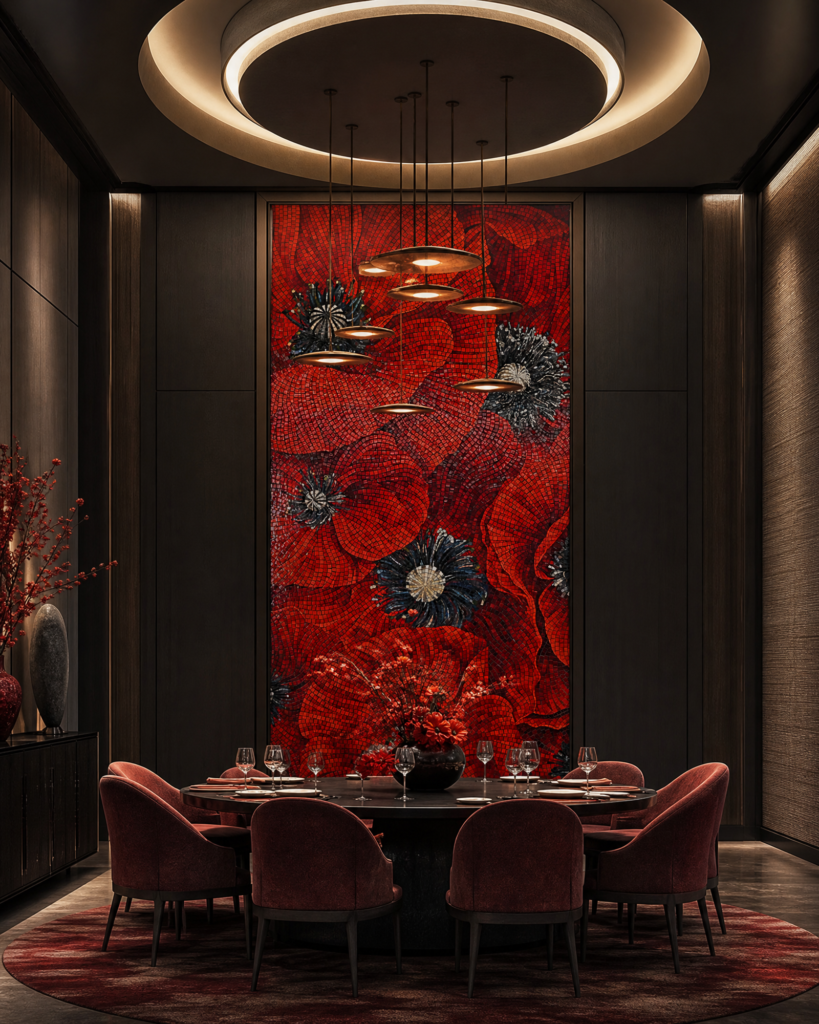
If Golden Nocturne feels theatrical, Crimson Bloom is almost visceral.
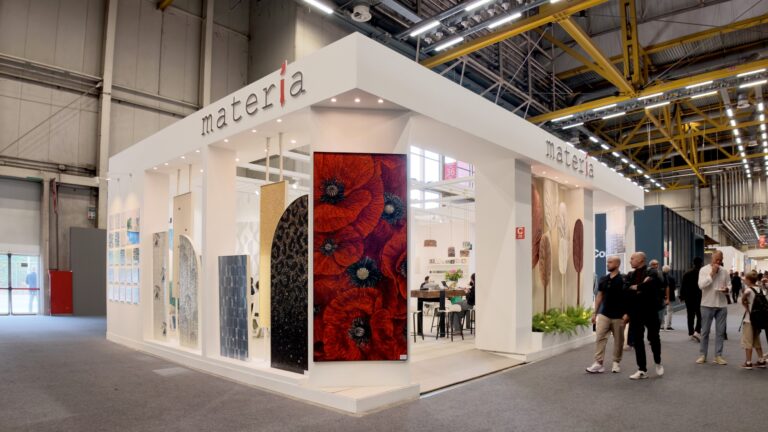
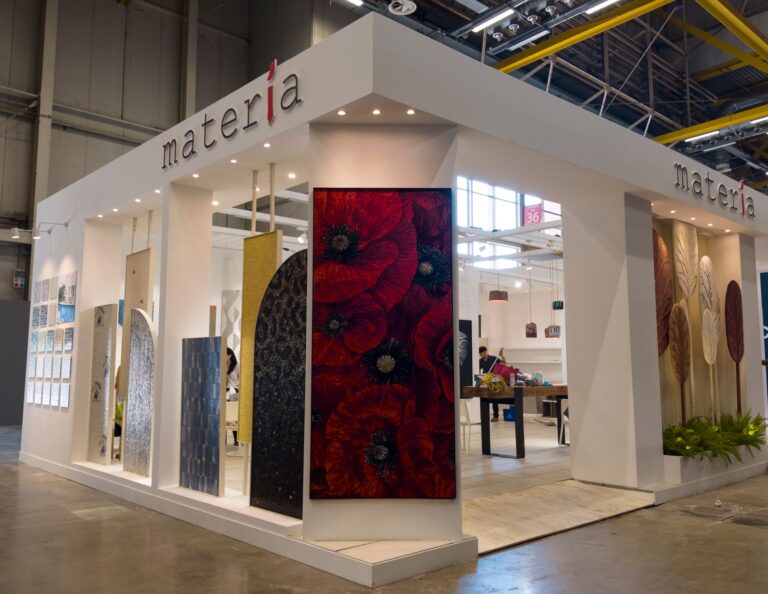
Its layered red poppies fill the entire visual field. There is no conventional garden, vase, horizon, or surrounding scenery to create distance between the flowers and the viewer. Instead, the eye is drawn directly into translucent petals, shadowed folds, and dark, textured centers.
Red gives the work its physical intensity. The color suggests passion, vitality, desire, and beauty, but poppies also carry more complex associations with sleep, remembrance, fragility, and mortality. This tension keeps the composition from becoming merely decorative.
Viewed from across a room, the work reads as a concentrated field of crimson. At closer range, its hand-cut details reveal subtle shifts in color and texture. The result sits somewhere between botanical imagery and abstraction.
This is floral mosaic wall art for a space that can support a strong emotional presence. A minimalist dining room, sophisticated living area, or carefully lit entrance would allow its saturated color to feel deliberate rather than overwhelming.
Visual character: Passionate, immersive, emotionally charged
Best suited to: Dining rooms, living rooms, and dramatic entryways
3. Blooming Grace: Roses Rendered Like a Painting
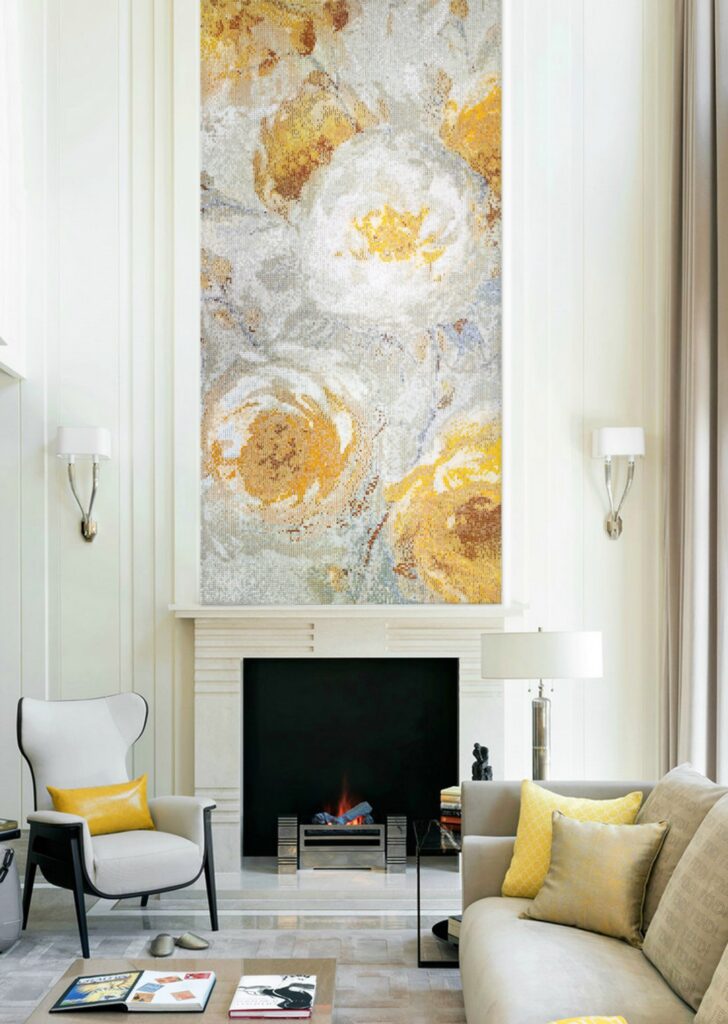
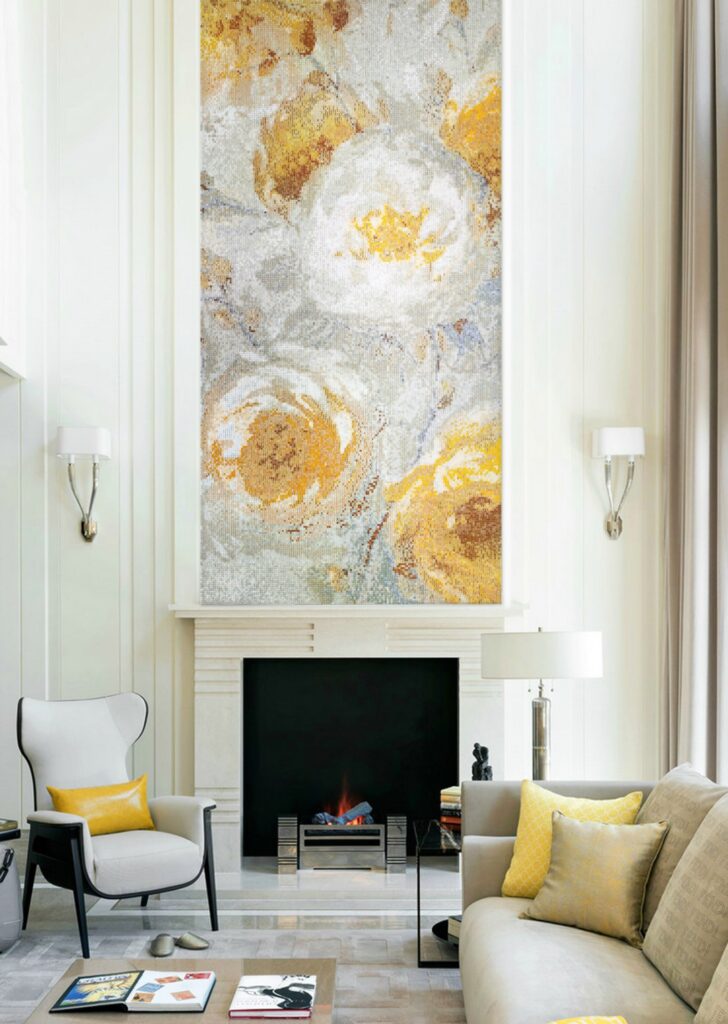
After the intensity of Crimson Bloom, Blooming Grace introduces a softer and more luminous interpretation of floral beauty.
Large roses emerge through translucent layers of ivory, warm amber, muted gold, and grey. Their edges are not uniformly sharp. Some dissolve gently into the background, creating a dreamlike transition between flower and atmosphere.
Variations in scale give the composition a generous rhythm. The largest blossoms provide immediate visual impact, while smaller and partially obscured petals encourage slower viewing. Warm amber tones bring energy to the work without disrupting its understated palette.
Roses traditionally symbolize love, beauty, and the fullness of life. Here, ivory adds purity and grace, while amber and gold suggest warmth, confidence, and the radiant energy of a flower opening.
The mosaic demonstrates how a hard architectural material can produce an unexpectedly soft effect. From a distance, the transitions feel almost like diluted paint. Up close, the individual pieces reveal the craftsmanship behind that illusion.
Its vertical 1,500 × 3,000 mm format works particularly well in tall interiors and narrow feature-wall locations. The result is elegant enough for a residential living or dining room, yet distinctive enough for boutique hotels, restaurants, and beauty spaces.
Visual character: Warm, graceful, painterly
Best suited to: Living rooms, bedrooms, restaurants, boutique hotels, and beauty interiors
4. Floral Tapestry: An Immersive Blue Garden
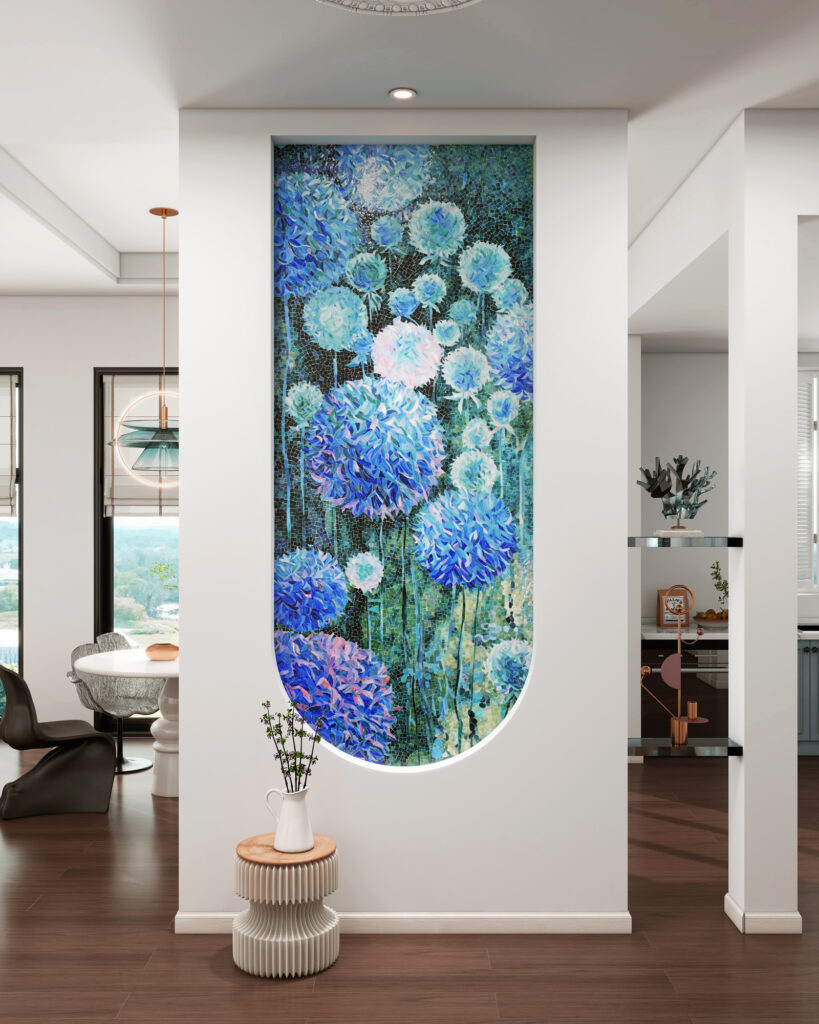
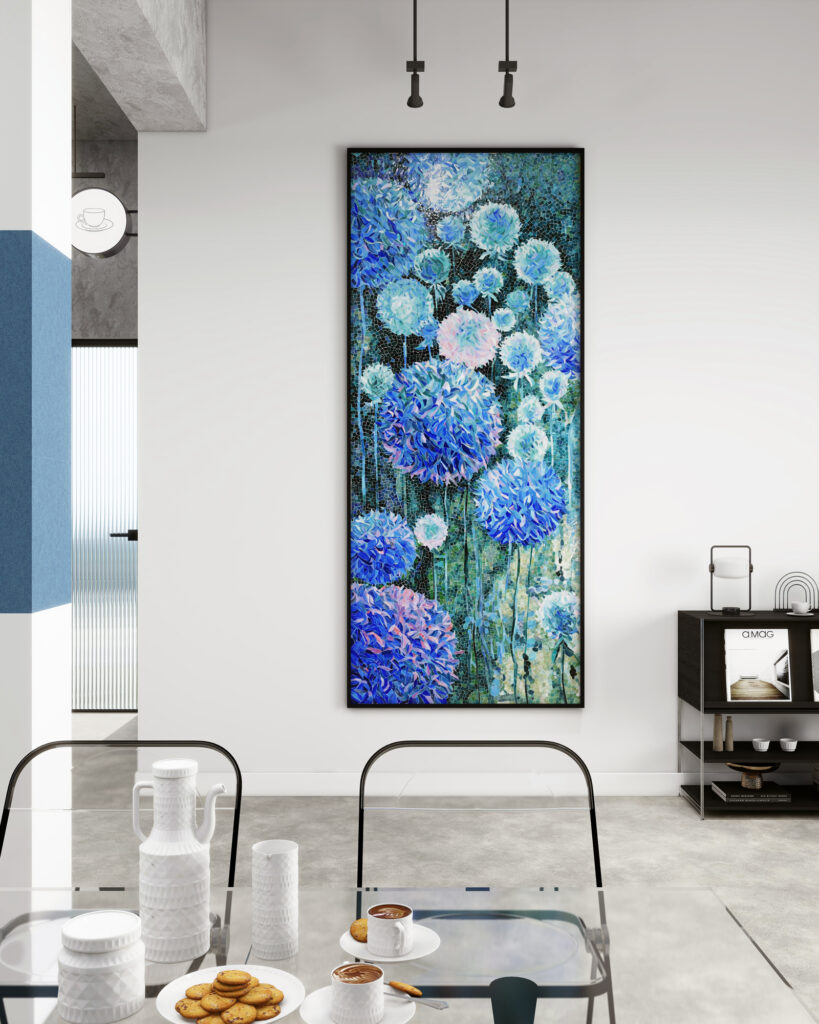
Floral Tapestry moves the visual journey from warm, painterly roses into a cool and immersive garden.
Clusters of blue, turquoise, and soft violet blossoms rise on slender stems from a deep background. Some flowers are clearly defined, while others seem to dissolve into the surrounding darkness. Changes in scale create the impression of foreground and distance, turning the vertical composition into a landscape rather than a flat pattern.
Small luminous highlights scattered across the petals are particularly important. Mosaic naturally responds to changing light, so these details can shimmer as the viewing angle changes. The darker background intensifies that effect, making individual blossoms appear almost suspended in space.
The work feels calming without becoming passive. Its upward-growing stems create movement while suggesting gradual growth, resilience, and aspiration.
Its cool palette makes it a natural choice for boutique hotels, bedrooms, wellness environments, beauty spaces, or residential interiors intended to feel quiet and restorative.
Visual character: Immersive, tranquil, dreamlike
Best suited to: Boutique hotels, bedrooms, spas, and wellness interiors
5. Whispers Among Flowers: A Mosaic Built From Memory
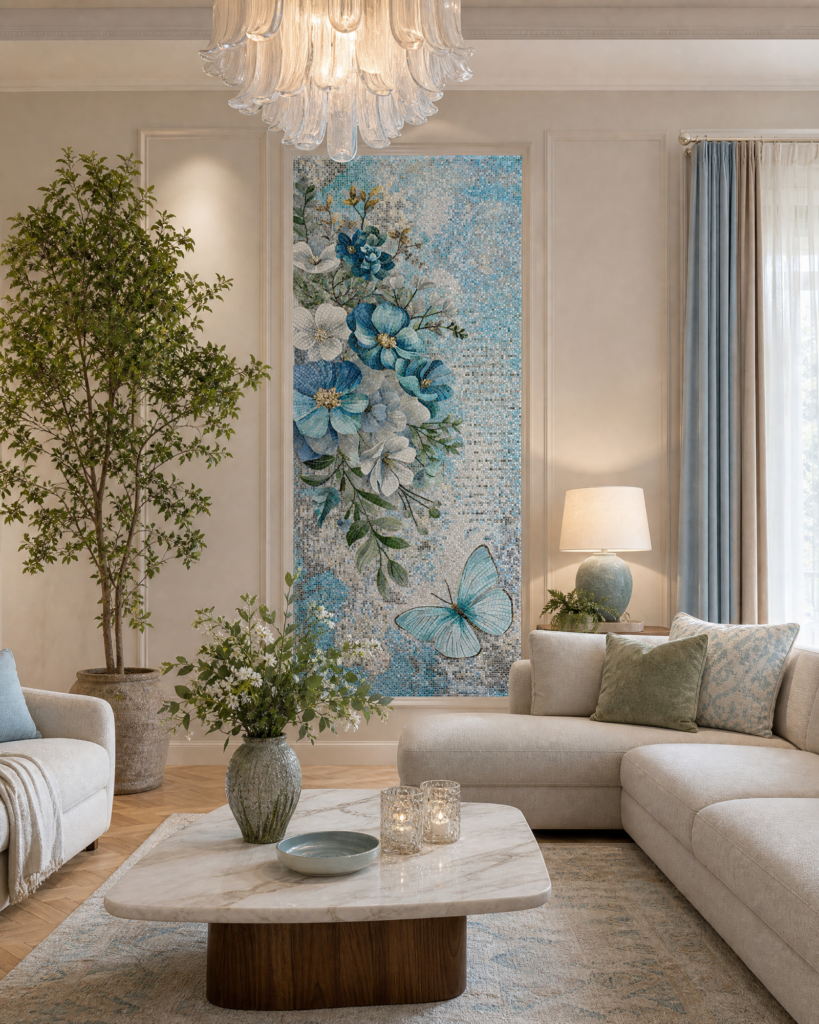
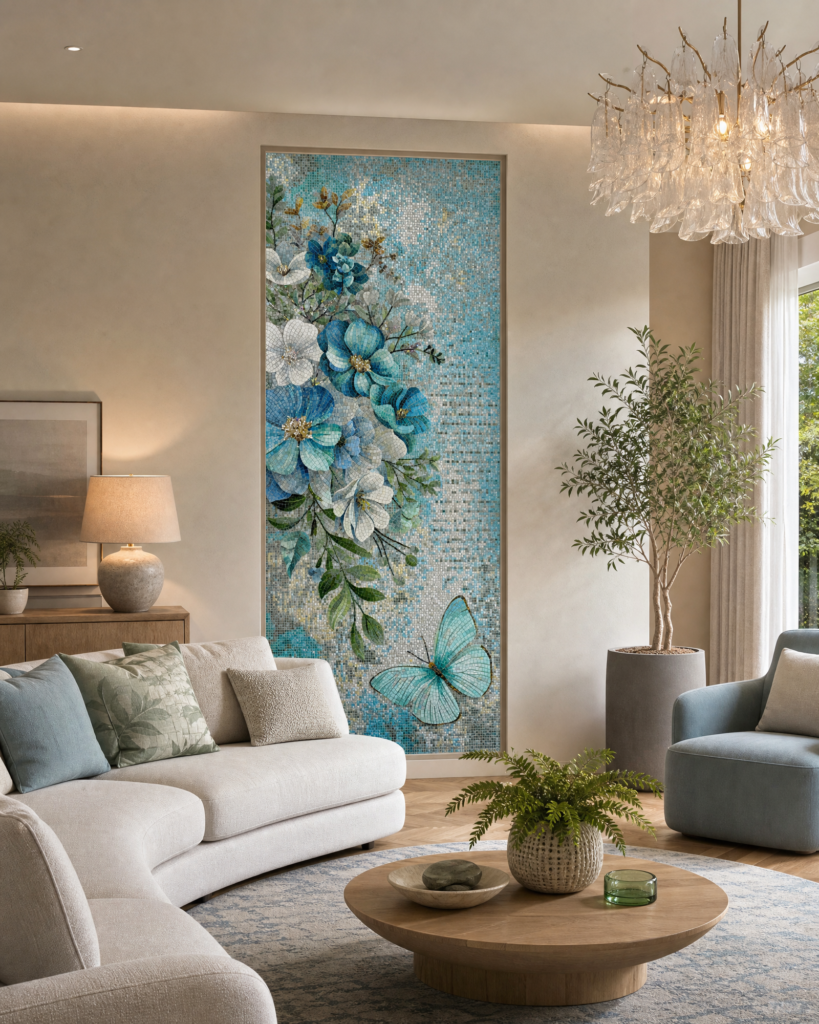
Not all floral art is concerned with botanical realism. Whispers Among Flowers combines nature with fragments of material culture and memory.
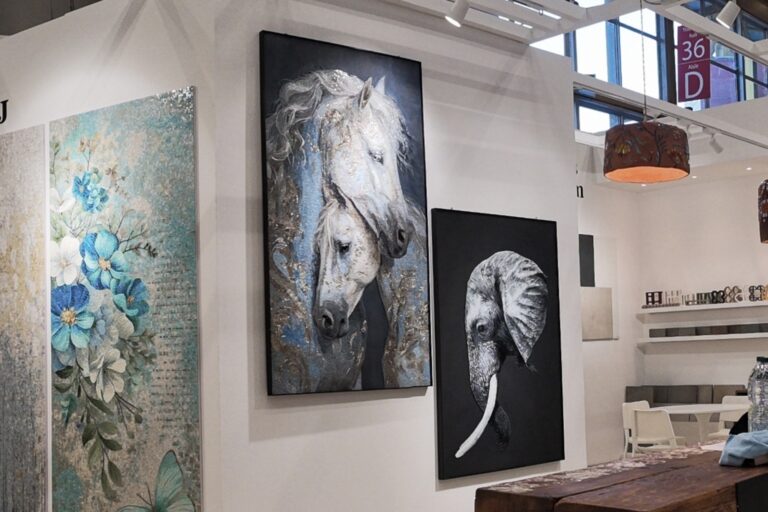
Blue and white flowers, green foliage, and a turquoise butterfly appear alongside vintage script, lace-like elements, linen textures, and halftone patterns. These details create a layered surface that feels part garden, part textile, and part faded letter.
Its muted blue, grey, and white palette has a gentle, restorative quality. Rather than relying on bright color, the artwork focuses attention on texture, atmosphere, and suggestion. Distressed areas evoke the softness of age, while the butterfly introduces movement and transformation.
The composition feels romantic without becoming sentimental. Its poetic tension comes from the meeting of the natural and the human-made: flowers and wings are placed against traces of writing, cloth, and remembered objects.
This piece would work beautifully in an entryway, intimate dining space, boutique hospitality project, or interior that combines contemporary furnishings with vintage references.
Visual character: Poetic, nostalgic, quietly romantic
Best suited to: Entryways, boutique interiors, intimate dining spaces, and refined residences
6. Green Jade With Misty Peony: Flowers Within an Ink-Wash Landscape
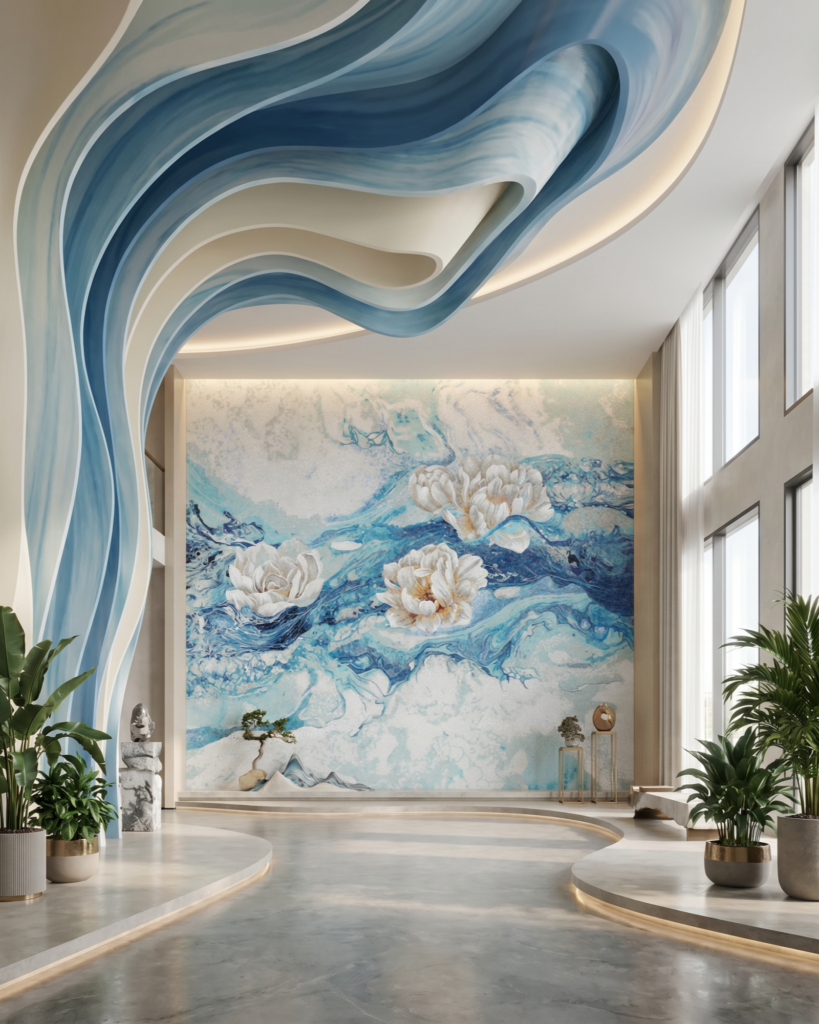
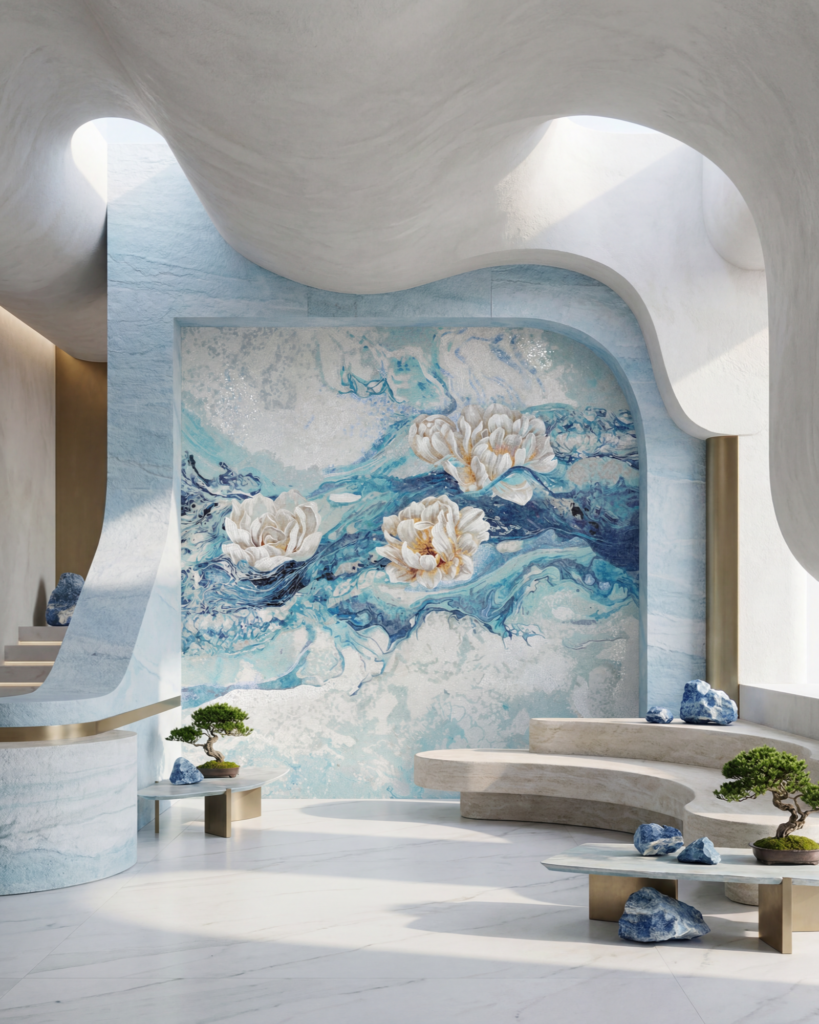
Green Jade With Misty Peony approaches floral wall art through the atmosphere of traditional Eastern painting.
Luminous white peonies drift across broad currents of turquoise, blue, jade, and soft grey. The background can be read in several ways: flowing water, rolling mist, polished stone, or diluted ink moving across paper.
This ambiguity is central to the design. Instead of separating the flowers from the landscape, the composition allows them to merge. The peonies provide gentle points of focus, while the fluid background gives the eye room to travel.
The symbolism deepens its architectural appeal. Peonies have long been associated with prosperity, grace, and fulfilled affection. Flowing water suggests continuity, adaptability, and abundance, while mist introduces stillness and contemplation.
At 3,200 × 3,000 mm, this is one of the most expansive works in the selection. Its scale and horizontal movement make it particularly compelling in hotel lobbies, private clubs, tea rooms, wellness spaces, or generous residential interiors.
It does not dominate through saturated color. Instead, it changes the atmosphere of the room by creating a sense of visual distance—as though the wall opens into a mist-filled landscape.
Visual character: Serene, expansive, atmospheric
Best suited to: Hotel lobbies, tea rooms, private clubs, and wellness spaces
7. Lotus Reverie: A Contemporary Expression of Eastern Symbolism
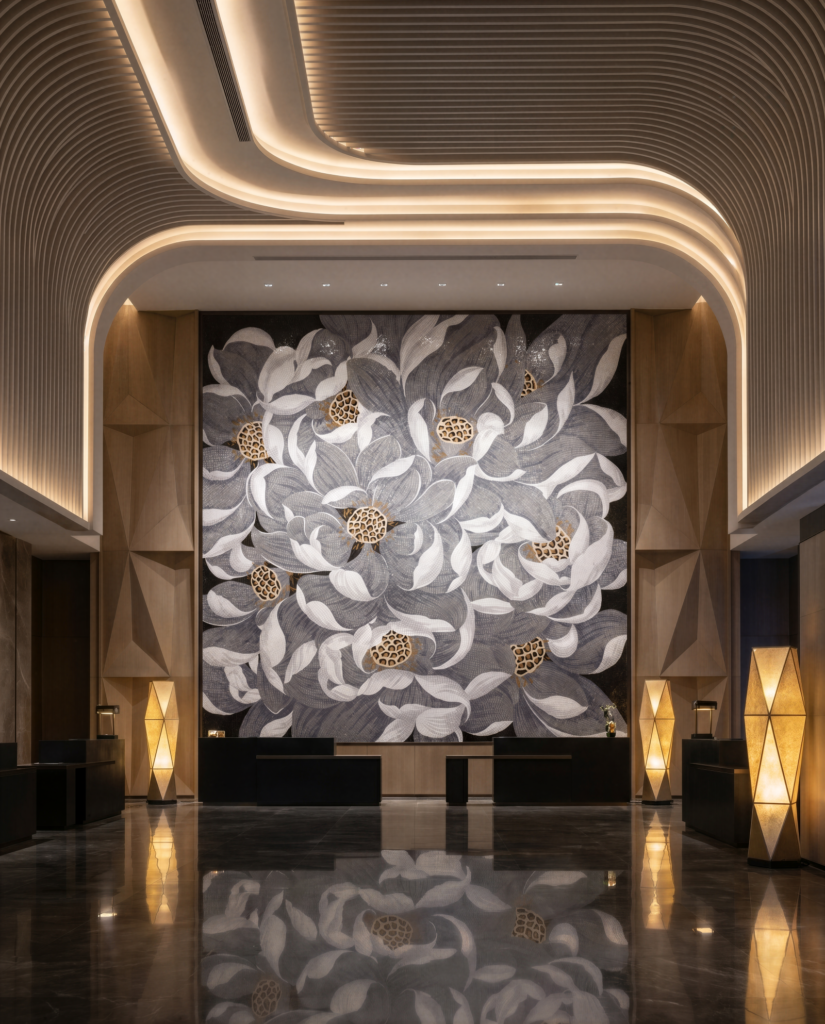
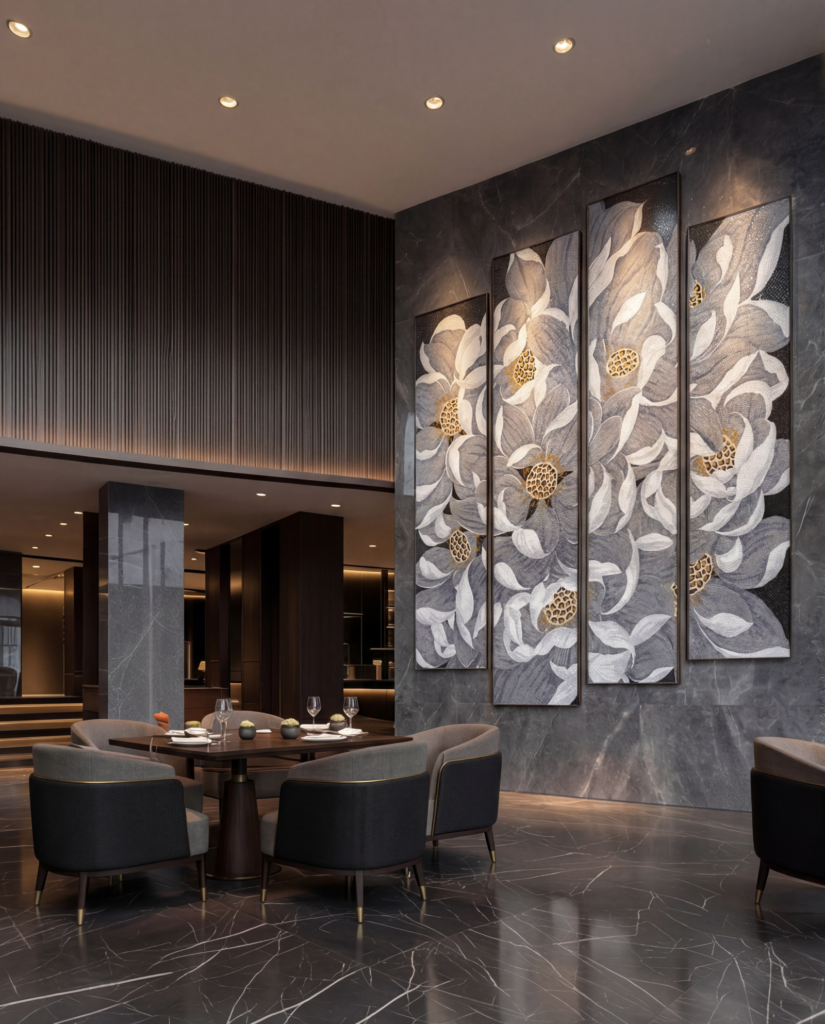
The visual journey ends with Lotus Reverie, a composition centered on purity, renewal, and inner calm.
The lotus has appeared in art and architecture for centuries, but this interpretation avoids feeling like a historical reproduction.
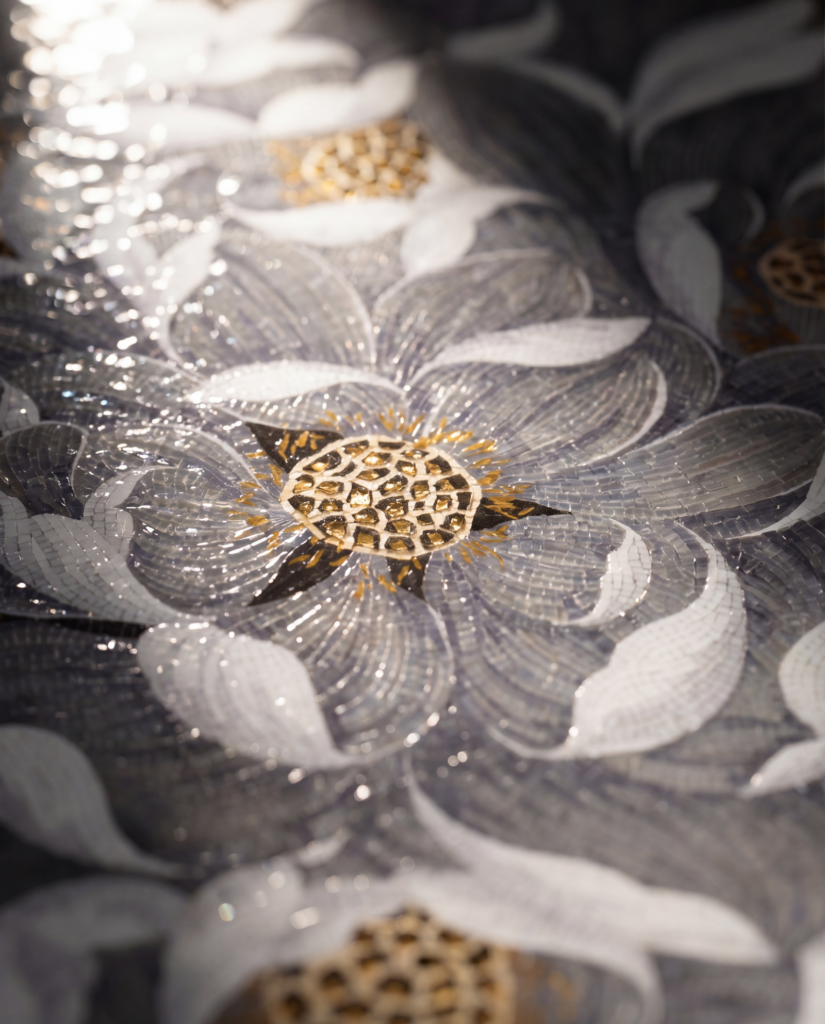
Blooming white lotuses, curling petals, and golden seed pods are arranged within a restrained palette of grey, ivory, and warm metallic tones. Fine mosaic pieces follow the natural contours and delicate veins of the petals, allowing the surface to reveal more detail as the viewer approaches.
The lotus traditionally symbolizes purity and renewal: a flower that rises cleanly from muddy water. Seed pods add ideas of abundance, continuity, and fulfillment. These meanings are present without becoming overly literal, giving the artwork both cultural depth and contemporary versatility.
Its 3,000 × 3,000 mm format creates an enveloping wall surface rather than an isolated decorative panel. Gentle grey tones maintain a sense of calm, while golden accents prevent the composition from feeling cold.
This balance makes Lotus Reverie especially appropriate for wellness interiors, contemplative residential spaces, elegant reception areas, and commercial settings seeking a quieter expression of luxury.
As the final work in the collection, it provides a natural moment of stillness—a garden no longer experienced through drama or nostalgia, but through reflection.
Visual character: Meditative, refined, symbolic
Best suited to: Wellness spaces, reception areas, residences, and tranquil commercial interiors
Why Floral Mosaics Feel Different From Floral Wallpaper
From a distance, a mosaic mural may have the pictorial presence of a painting or printed wall covering. Up close, however, the experience changes completely.
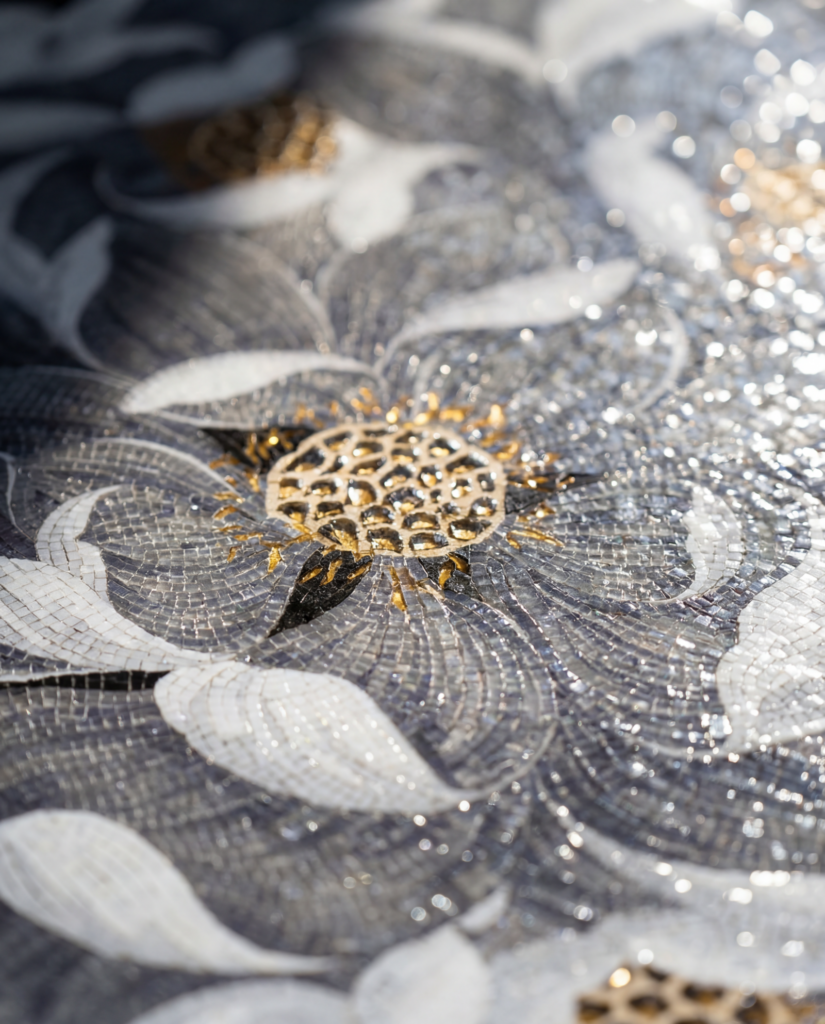
Every petal is built from individual pieces. Their edges determine the direction of a curve. Small shifts in tone form shadows and highlights. Reflective surfaces respond to daylight, artificial lighting, and the movement of people through the room.
As a result, the image is never entirely fixed. A gold detail that appears subtle in the morning may become prominent under evening lighting. A blue flower may look almost flat from one angle and luminous from another.
This relationship with light is one reason floral mosaics work so well at architectural scale. The flowers are not simply represented on the surface—the material gives them physical presence.
Unlike wallpaper, a mosaic is not merely applied decoration. Its texture, joints, reflections, and handcrafted irregularities become part of how the artwork is experienced.


How to Choose the Right Floral Mosaic Wall Art
A successful floral mural should respond to the architecture around it. Before selecting a design, consider four questions.
What should the room feel like?
Crimson and gold can create energy and drama. Blue and violet tend to feel immersive and contemplative. Ivory, grey, and soft amber support calm, elegant interiors.
The most beautiful design is not necessarily the right one for every project. Its emotional tone should complement the purpose of the room.
How will the artwork be viewed?
A tall, narrow composition can emphasize ceiling height or define an entryway. A large horizontal mural can visually expand a lobby or lounge.
Viewing distance also affects the ideal level of detail. Bold forms remain legible across a large room, while intricate textures reward closer observation.
How does light move through the space?
Mosaic is highly responsive to illumination. Directional lighting can emphasize surface texture, while daylight creates gradual changes throughout the day.
Whenever possible, material and color samples should be reviewed under the project’s actual lighting conditions rather than selected from a screen alone.
Should the artwork dominate or integrate?
A saturated work such as Crimson Bloom is designed to become the center of attention. A quieter composition such as Lotus Reverie can integrate with stone, wood, textiles, and restrained furnishings while still giving the room a distinctive identity.
The surrounding materials should support this intention. A visually powerful mural often benefits from simpler furniture and finishes, while a subtle mosaic can become part of a more layered interior.
A Garden That Does Not Fade With the Season
These seven works reveal how broad the language of floral mosaic can be.
Flowers can become intense fields of color, quiet symbols of renewal, fragments of memory, or elements within an expansive imagined landscape. Mosaic gives permanence to these fleeting natural forms while preserving their sense of movement through color, texture, and reflected light.
The most compelling floral mosaic wall art does more than reproduce a beautiful flower. It captures an atmosphere—and gives that atmosphere an architectural presence.
Whether the desired mood is dramatic, contemplative, romantic, or serene, the right floral composition can turn an ordinary wall into a garden that changes with the light but never with the season.