Introduction
Custom pool mosaic designs can turn a swimming pool from a functional water feature into a distinctive part of the surrounding architecture. Depending on the project, a custom mosaic may cover the entire basin, create a focused floor feature, define a border or appear within a selected part of the pool.
The right approach depends on more than visual preference. Pool shape, scale, water depth, lighting, viewing angle and the surrounding landscape all influence how colors and patterns appear underwater. A design intended for a resort pool viewed from above may require a different composition from one created for an indoor spa or private villa.
This guide explores how to choose between standard surfaces and custom patterns, where to position mosaic artwork, and how water, light and viewing angle affect the final design. For broader material and project support, explore JNJMosaic’s swimming pool and spa mosaic solutions.
Standard Pool Mosaic or Custom Pattern: Which Approach Fits Your Project?
Choosing between a standard mosaic surface and a custom pool mosaic pattern is not simply a question of which option looks more impressive. The decision should reflect the role of the pool within the wider space, the intended viewing experience and the level of visual emphasis required.
In some projects, the pool needs to remain a calm extension of the architecture. In others, it is designed as the central feature of a hotel, resort, clubhouse or private villa.
Standard Mosaic Surfaces
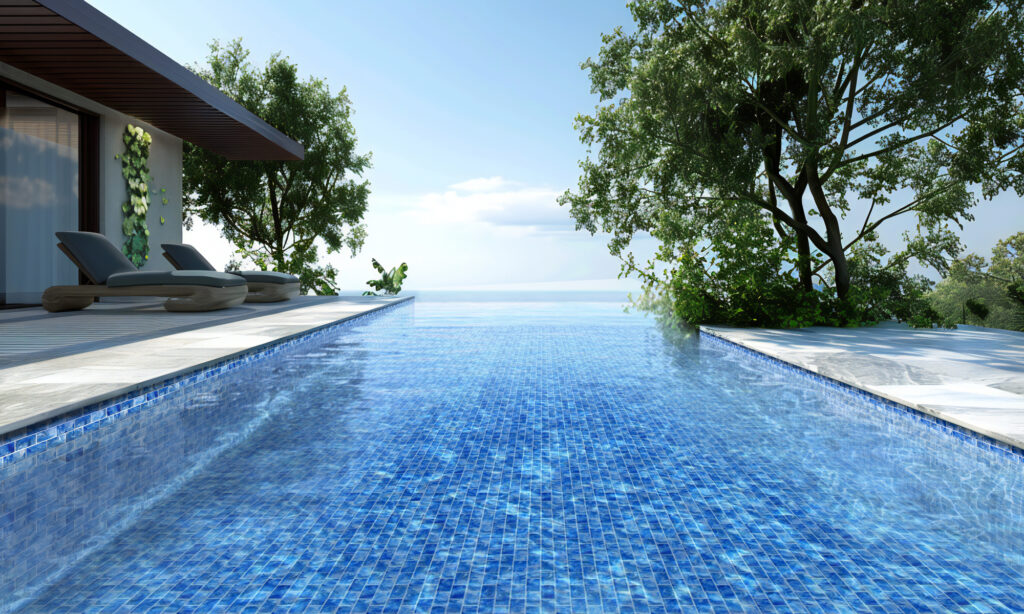
Standard mosaic surfaces use a consistent tile color, blend or format across most or all of the pool interior. Their strength lies in creating a continuous underwater finish that supports the architecture rather than competing with it.
This approach is particularly suitable for:
- Infinity pools where the water surface should merge visually with the horizon
- Spas and wellness pools that require a calm, restrained atmosphere
- Pools with curved walls, steps, benches or irregular transitions
- Modern architectural settings with a minimal material palette
- Projects where water color, reflection and surface texture are the primary design features
Standard mosaics do not have to appear flat or uniform. Variations in blue, aqua, green, white and iridescent tones can add movement and depth as natural or artificial light passes through the water. Different chip shapes, finishes and layouts can also influence whether the surface feels structured, fluid, bright or atmospheric.
Designers can explore mosaic tiles by color, shape and application when reviewing options for pool, spa and other architectural surfaces.
Custom Pool Mosaic Patterns
A custom pool mosaic pattern is more appropriate when the pool is expected to become a recognizable visual feature. Instead of serving only as a background surface, the mosaic contributes a theme, image, rhythm or sense of identity to the project.
Custom patterns can be developed as:
- Full-basin artistic compositions
- Central floor features
- Decorative borders
- Abstract lines and gradients
- Botanical or geometric motifs
- Artwork-inspired designs
- Logos or project-specific graphic elements
This approach is especially effective in hotel and resort pools, private clubs, luxury villas and other spaces where guests can view the pool from terraces, balconies, guestrooms or elevated public areas. A strong overhead viewing angle allows the overall composition to be understood as a complete image.
However, more detail does not always create a better result. Water movement can soften edges and distort small elements, while an overly dense pattern may compete with the surrounding architecture. The scale, contrast and placement of the artwork therefore need to be considered in relation to the pool’s dimensions and primary viewing distance.
| Approach | Best suited to | Visual effect | Planning level |
|---|---|---|---|
| Standard mosaic surface | Infinity pools, spas and restrained architectural spaces | Continuous and understated | Lower |
| Feature mosaic panel | Villas, boutique hotels and branded environments | Creates a defined focal point | Medium |
| Full-basin mosaic artwork | Resorts, clubhouses and statement pools | Immersive and highly distinctive | Higher |
The most suitable approach ultimately depends on what the pool needs to achieve. A standard mosaic surface supports a continuous and restrained visual effect, while a custom pattern gives the pool a stronger artistic identity. The decision should be made according to the project’s architecture, intended atmosphere and primary viewing position.
6 Custom Pool Mosaic Design Directions
A custom pool mosaic should respond to the architecture, pool shape and intended atmosphere rather than function as an isolated decoration. Some compositions create a bold destination feature, while others use restrained patterns to add movement without overwhelming the surrounding space.
The following six directions illustrate how pattern, scale and color can be adapted for hotel, resort, clubhouse, spa and private villa pools.
1. Flowing Botanical Patterns
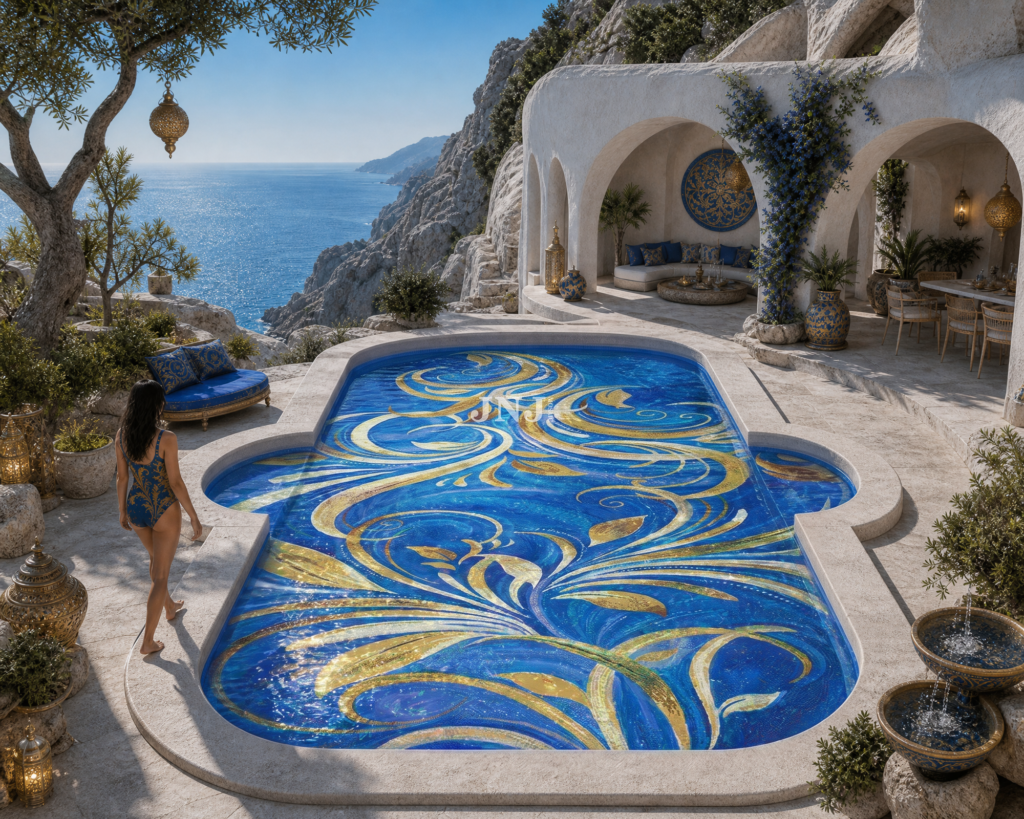
Botanical compositions use leaves, vines, flowers and curved stems to introduce organic movement across the pool surface. They work particularly well in free-form pools because the lines can follow rounded edges and irregular contours instead of being confined to a rigid grid.
For a coastal villa or landscape-led resort, blue and turquoise base tones can connect the water with the surrounding environment, while gold, green or pale aqua accents make the botanical forms more visible. The level of contrast should reflect the intended mood: stronger contrast creates a dramatic focal point, while closely related tones produce a quieter, more integrated result.
Botanical patterns are especially suited to pools surrounded by gardens, natural stone, Mediterranean-style architecture or tropical planting. Before finalizing the composition, designers should consider how much of the pattern will be visible from the pool deck and whether guests will also view it from terraces or upper floors.
2. Classical Framed Compositions
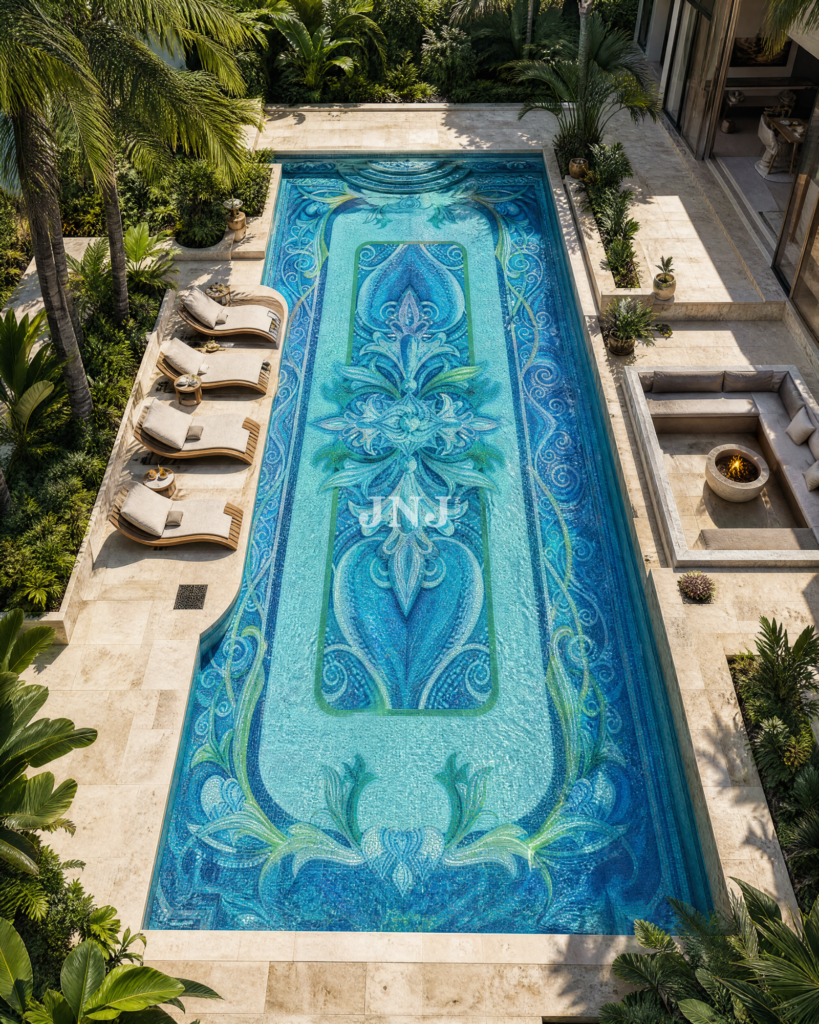
Framed pool mosaics organize the basin through borders, central medallions and symmetrical motifs. This approach works best in rectangular pools or other spaces with a clear central axis, where the mosaic can reinforce the proportions of the architecture.
A decorative border helps define the perimeter, while a central composition draws attention along the length of the pool. Repeated elements can also connect the artwork with nearby columns, arches, paving or landscape features.
Because the complete design is most legible from above, a classical framed composition is a strong option for courtyard villas, resort pools overlooked by guestrooms and hotel pools visible from balconies.
The pattern should be scaled to the full dimensions of the basin. Details that look clear in a small drawing may lose definition once viewed through moving water and from a greater distance.
3. Fine-Art-Inspired Pools
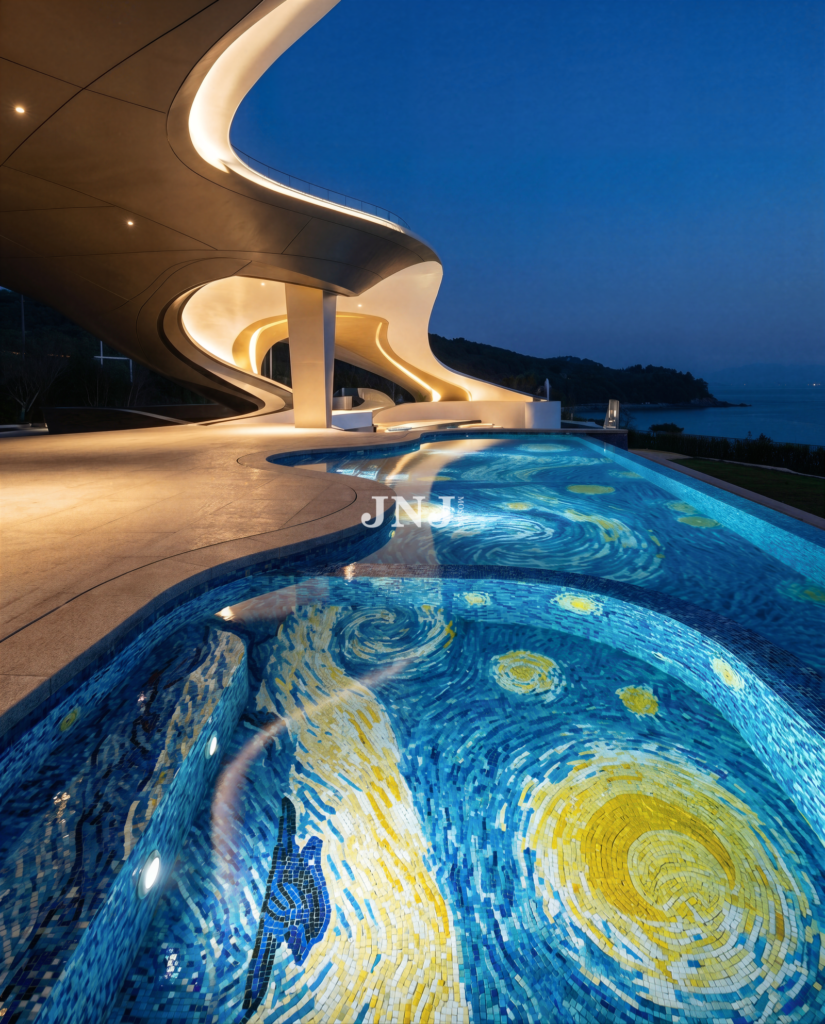
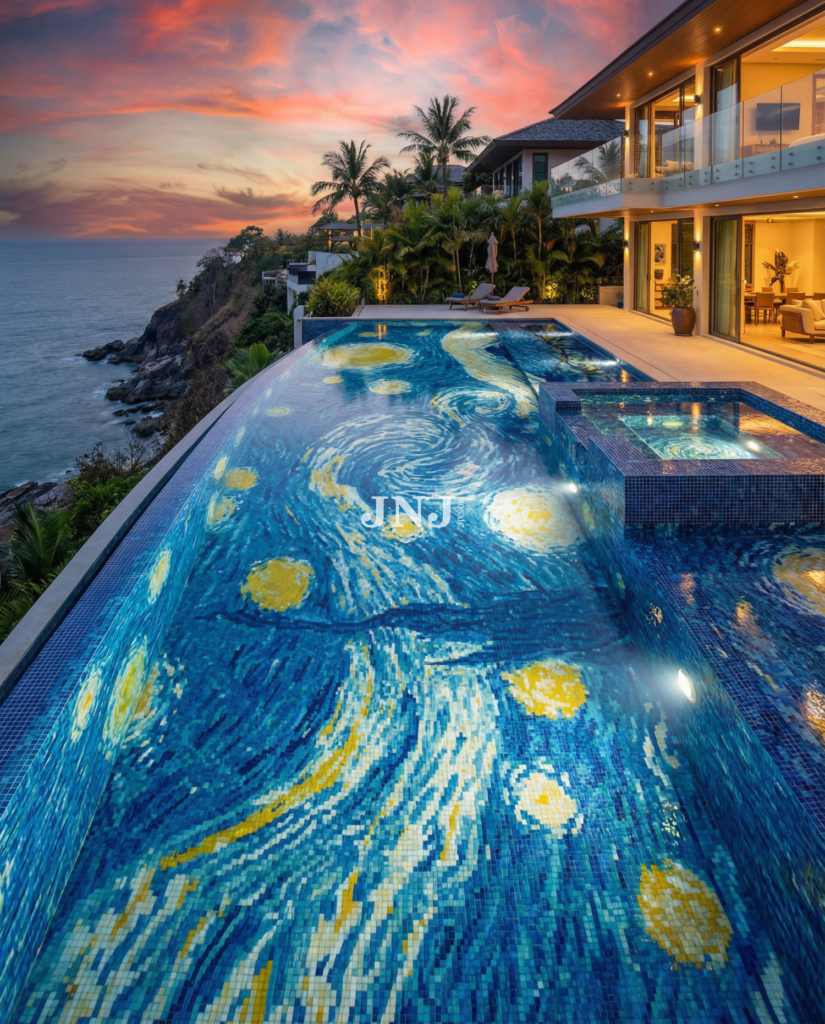
A pool can also become a canvas for translating a painting or other visual artwork into an architectural surface. Rather than reproducing every detail literally, the mosaic composition may reinterpret recognizable colors, lines and areas of movement so that they remain effective at pool scale.
This direction is suited to clubhouses, cultural hospitality projects and signature spaces where the pool is expected to offer an experience beyond recreation. Swirling forms, layered blues and contrasting highlights can interact with ripples and reflections, allowing the image to appear different throughout the day.
Art-inspired designs require careful attention to resolution and viewing distance. Very small details may become visually fragmented underwater, while broader shapes and controlled color transitions tend to remain more legible.
The pool’s steps, drains, lights and structural divisions should also be considered within the composition rather than treated as afterthoughts.
JNJMosaic has applied this approach in a clubhouse swimming pool inspired by Vincent van Gogh’s Starry Night. The completed project is discussed in greater detail later in this guide.
4. Abstract Lines and Movement
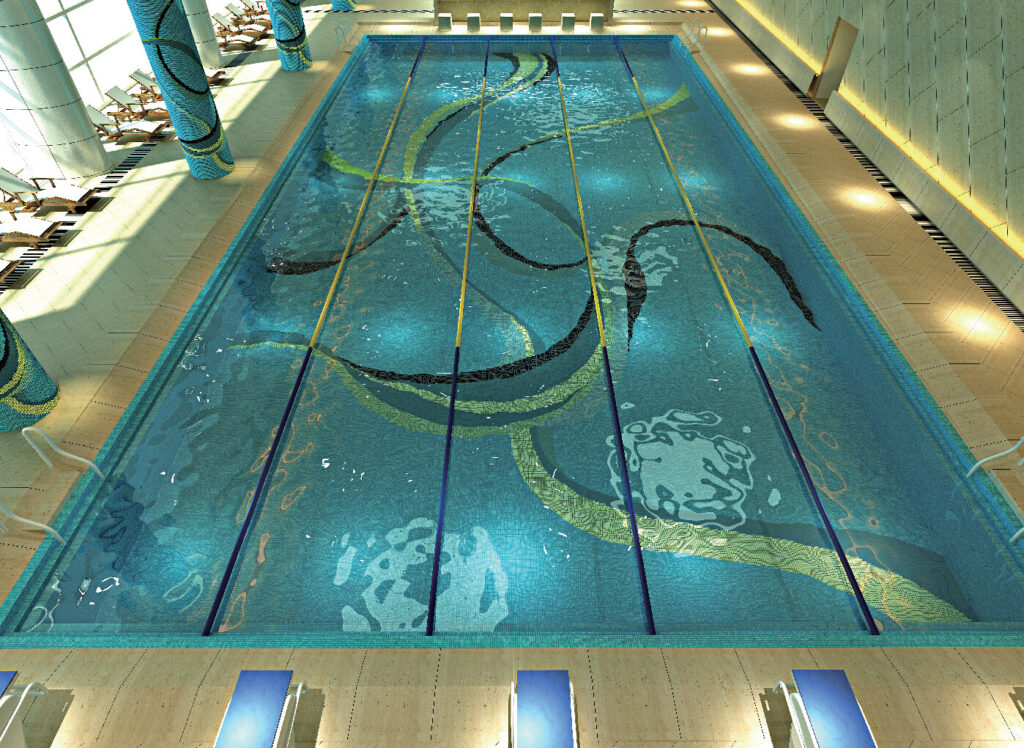
Abstract mosaic patterns can express motion without relying on a recognizable image. Curves, overlapping lines, waves and tonal transitions introduce visual rhythm while leaving more room for individual interpretation.
This approach is particularly useful for indoor pools, wellness centers and contemporary hotels, where a figurative or strongly themed image might feel too dominant. Flowing lines can follow the length of a lap pool, guide the eye toward a feature wall or create a sense of continuity across the aquatic space.
For a calmer result, designers can work with closely related shades of blue, aqua, gray or green. A small amount of contrasting color can then be used to define direction or highlight selected areas.
Wider, simplified lines are generally more effective from a distance than numerous fine details, especially where water movement continuously alters the image.
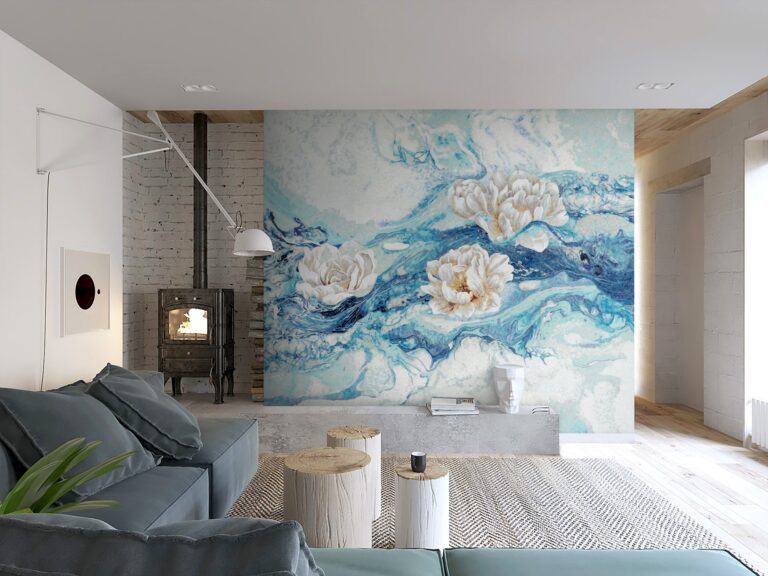
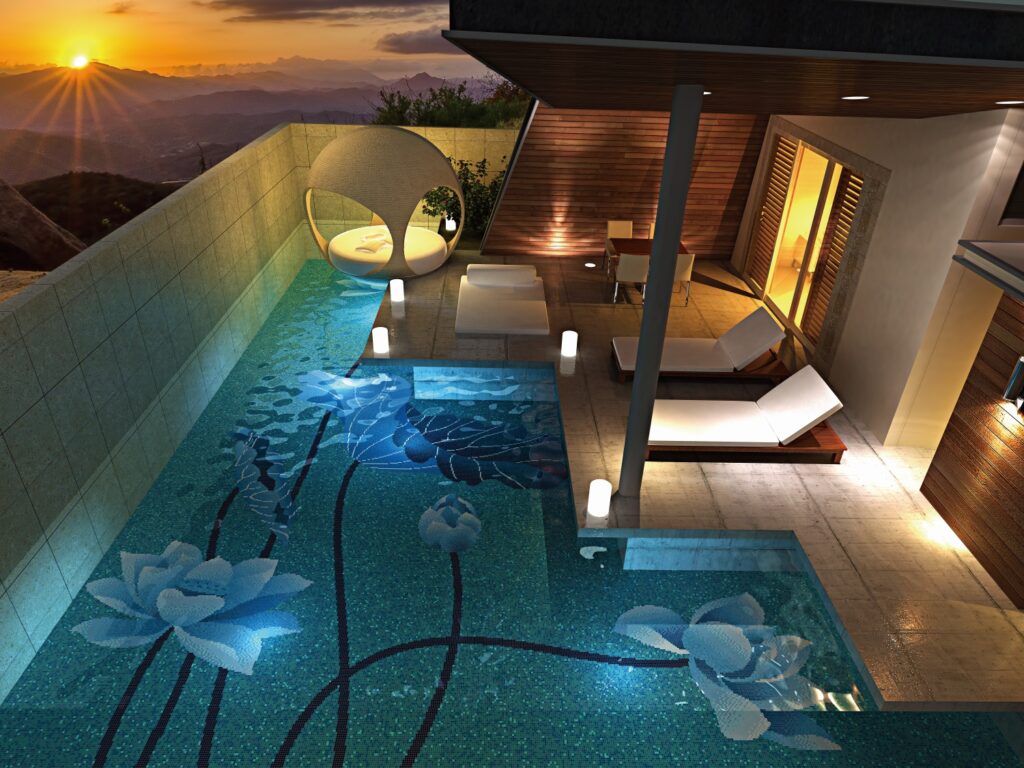
5. Floral Feature Pools
Large floral motifs offer a softer and more decorative alternative to geometric or fully abstract compositions. They can be used as a single central feature, repeated across the pool floor or extended into a full-basin artwork.
A floral design is well suited to private villas, destination spas and themed resort environments. The surrounding architecture should guide the choice of flower, palette and level of detail.
Pale blossoms against a blue-green background can create a tranquil atmosphere, while darker outlines and stronger color contrasts produce a more theatrical result.
The composition does not always need to fill the entire pool. Positioning a floral feature near the main viewing area, shallow shelf or lounge zone can create impact while allowing the remaining surface to stay visually quieter. This can also help connect the artwork with adjacent planting, landscape design or interior decorative elements.
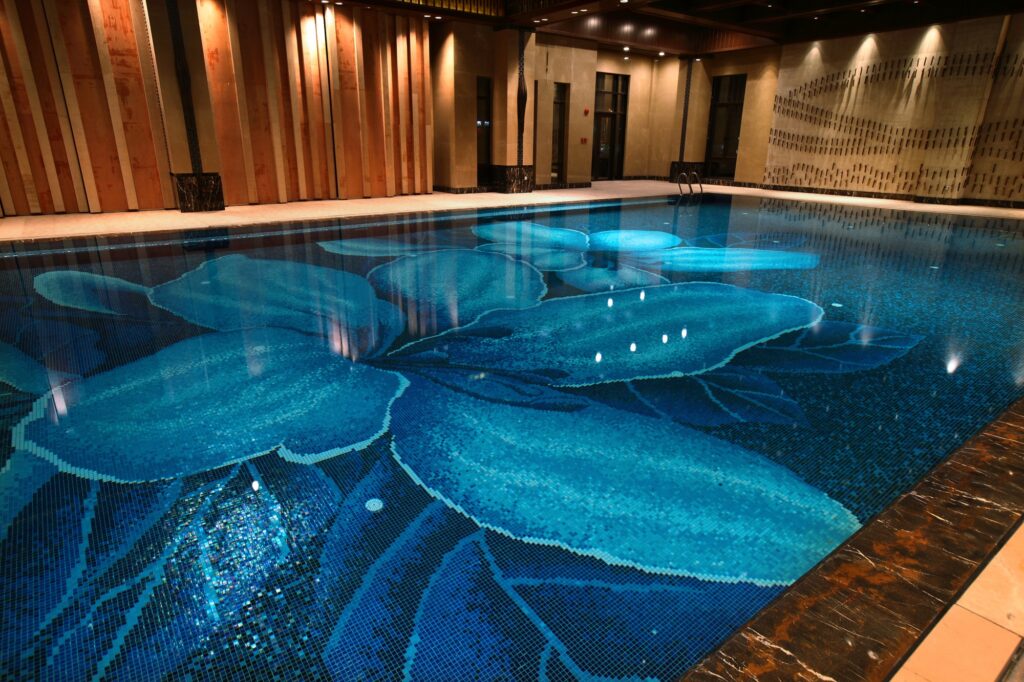
6. Tone-on-Tone Geometric and Pixel Patterns
Not every custom pool needs a recognizable image. Tone-on-tone patterns use variations within a limited color family to create subtle geometry, pixelated gradients or large abstract forms.
This direction works well in contemporary hotels, indoor pools and spa environments where the design should feel distinctive but restrained. Square mosaic modules can build soft transitions between light and dark areas, allowing the pattern to emerge gradually rather than dominate the space.
Blue-on-blue compositions preserve a familiar aquatic character, while turquoise, green or neutral palettes can create a more individual atmosphere.
The result depends heavily on viewpoint and lighting. From close range, individual mosaic pieces and color variations remain visible. From a distance, they merge into a broader composition. Reviewing both perspectives helps determine whether the pattern provides enough definition for the intended space.
These design directions are not fixed templates. Botanical, classical, artistic, abstract, floral and geometric elements can be combined or simplified to suit a particular project.
The most successful composition is one that considers the pool as part of the complete environment, including its architecture, landscape, lighting and primary viewing positions.
Where Should a Pool Mosaic Pattern Be Placed?
The placement of a pool mosaic pattern affects how clearly it can be seen, how it interacts with swimmers and how naturally it connects with the pool’s structure. A design that works across a full rectangular basin may not suit a curved pool, shallow lounge area or compact spa.
Before selecting a location, identify the pool’s primary viewing points. These may include the pool deck, hotel guestrooms, upper-floor balconies, reception areas, restaurants or outdoor terraces.
The design should also account for steps, drains, lights, benches, lane markings and changes in water depth.
Full Pool Floor
Covering the full pool floor creates the most immersive result. It allows a botanical, abstract, geometric or artwork-inspired composition to extend across the entire basin and become part of the overall architectural experience.
This placement is most effective when:
- The pool can be viewed from above
- The basin has a clear, readable shape
- The project requires a strong visual identity
- The surrounding architecture is restrained enough to support a detailed pool surface
- The artwork can be planned around structural and functional elements
Large shapes and controlled color transitions are generally easier to read through moving water than numerous small details. In a long rectangular pool, the pattern can follow the main swimming direction. In a free-form basin, flowing lines can respond to the curves of the pool.
A full-floor design does not necessarily require equally strong detail in every area. Quieter sections can be introduced around steps, walls or transition zones so that the main composition remains clear.
Central Feature Panel
A central feature panel places the custom artwork within a defined area of the pool. This creates a recognizable focal point without requiring the pattern to cover the complete basin.
Central panels can accommodate:
- Geometric medallions
- Floral motifs
- Abstract compositions
- Logos or brand symbols
- Art-inspired details
- Cultural or regional references
This approach is suitable for private villas, boutique hotels, clubhouses and other projects that want a recognizable feature with a controlled visual presence.
The panel should be proportioned to the pool rather than treated as a small decorative insert. If it is too small, it may lose impact once viewed through water. If it is too large, the feature may no longer appear clearly defined.
Shallow Shelf or Entrance Area
A shallow shelf, sun ledge or pool entrance places the mosaic closer to the viewer and under a thinner layer of water. This can make smaller patterns and color details easier to appreciate than when they are positioned in the deepest part of the pool.
Suitable designs include:
- Compact botanical motifs
- Gentle gradients
- Repeating geometric patterns
- Small project-specific symbols
- Decorative transitions between the deck and pool interior
This placement can create a welcoming visual moment as users enter the water. It may also help distinguish a lounge or relaxation zone from the main swimming area.
Decorative elements should not make steps, level changes or circulation routes harder to recognize. Strong patterns should be coordinated with the project’s safety and accessibility requirements, and functional markings should remain clear.
Borders and Perimeter Patterns
A mosaic border can frame the pool without covering the entire floor in artwork. Borders are particularly effective in rectangular or symmetrical pools, where they reinforce the basin’s proportions and create a visual transition between the perimeter and central surface.
Border designs may use:
- Repeating geometric motifs
- Classical decorative details
- Flowing botanical lines
- Color gradients
- Project-specific colors
- Simplified elements taken from a larger central pattern
A border can remain subtle by using closely related tones, or it can create stronger definition through contrasting colors. It may run around the full perimeter or appear only along selected sides to emphasize a view or architectural axis.
The design should account for corners, curves, steps and waterline transitions. A pattern that does not resolve cleanly at these points can appear interrupted after installation.
Pool Walls, Spa Zones and Water Features
Custom patterns are not limited to horizontal pool floors. They can extend onto walls, benches, spa zones and related water features to create continuity across the aquatic environment.
Potential applications include:
- A pattern flowing from the pool floor onto a vertical wall
- Coordinated visual themes between the main pool and adjoining spa
- Decorative treatments on submerged seating
- Mosaic artwork on a water-feature wall
- Patterned surfaces around an overflow edge
- A visual link between indoor and outdoor pools
Vertical placement can make a mosaic easier to see from the pool deck, particularly when reflections obscure details on the floor. It can also help define a smaller spa or wellness area without introducing a full-basin composition.
For pools with complex curves or transitions, the artwork should be developed in relation to the actual geometry. A pattern designed only as a flat image may not align naturally when it turns across walls, corners or rounded surfaces.
Choosing the Primary Viewing Position
The best placement is usually determined by where the design should make its strongest impression.
A hotel pool viewed from guestrooms may benefit from a full-floor composition or strong central axis. A villa pool experienced mainly from the terrace may need the artwork oriented toward the house. An indoor spa may benefit more from a restrained pattern on a wall, bench or shallow zone than from a highly detailed pool floor.
Before confirming the layout, the project team should review:
- The pool plan and dimensions
- Water depth in each area
- Main viewing directions
- Natural and artificial lighting
- Steps, drains, lights and other fixed elements
- Adjacent architecture and landscape
- Areas where safety markings must remain clear
- Whether the design will be visible when the pool is in use
A custom pool mosaic is most effective when its position is planned as part of the pool architecture from the beginning. Placement should give the artwork enough space to be understood while preserving the clarity and function of the aquatic environment.
Check Water, Light and Viewing Angle Before Finalizing the Placement
A pool mosaic should not be evaluated only as a flat drawing or dry sample. Water, lighting and viewing position can significantly change how the pattern is perceived after installation.
Water movement softens edges and visually distorts small details. Designs intended to be seen from a distance therefore benefit from broader shapes, controlled color transitions and a clear overall composition. Water depth also affects perception: shallow shelves and steps may appear lighter, while the same mosaic can look deeper or more saturated in the main basin.
Natural and artificial light introduce further variation. Direct sunlight can strengthen reflections, while shaded conditions may make subtle tonal differences more visible. At night, underwater fixtures can highlight reflective pieces but may also create glare if their position is not coordinated with the pattern.
The design should also face the most important viewing position. A villa pool may be oriented toward the main terrace, while a hotel or resort pool may need to read clearly from guestrooms, balconies or elevated public areas.
Reviewing the composition from poolside and overhead perspectives helps confirm whether its scale, direction and contrast remain effective under realistic conditions.
Project Example: Reinterpreting Starry Night in a Clubhouse Pool
China Merchants Poly Tianyao Xu Clubhouse Pool
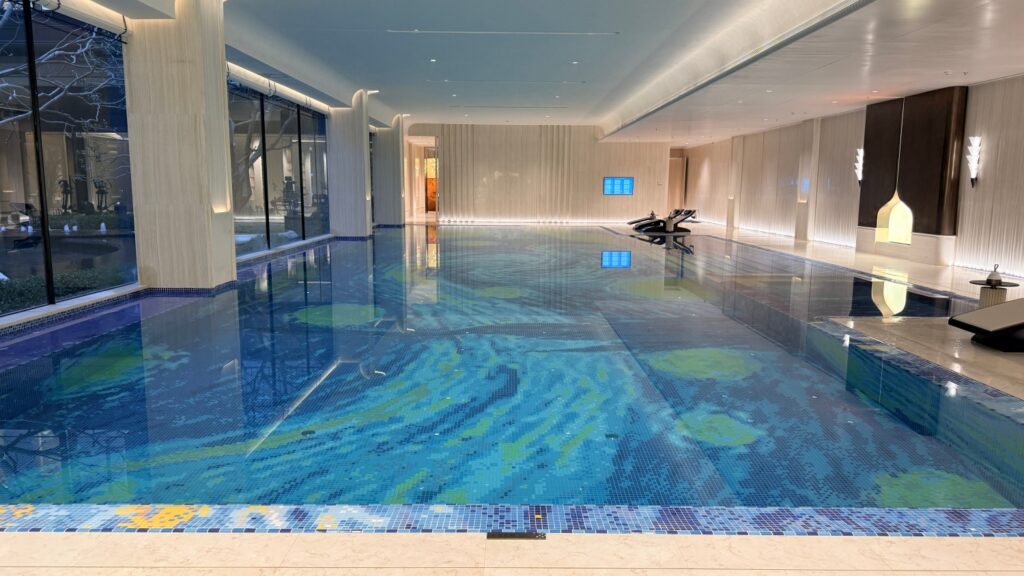
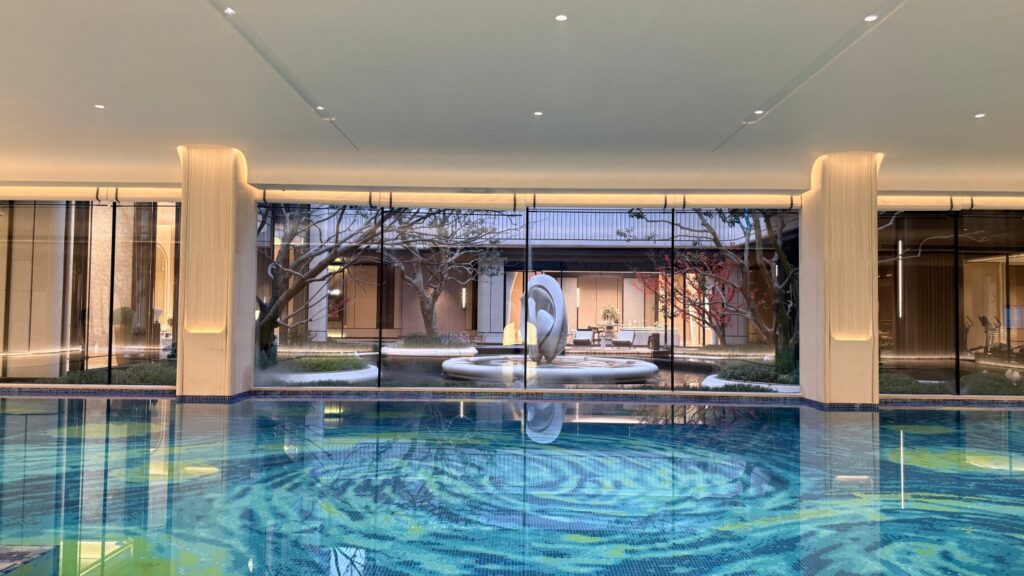
At the China Merchants Poly Tianyao Xu Clubhouse in Wenzhou, China, JNJMosaic collaborated with UHOUSE DESIGN to reinterpret Vincent van Gogh’s Starry Night as an immersive swimming pool mosaic.
Rather than reproducing the painting as a flat image, the composition translates its swirling sky, luminous stars and layered blue tones into a surface designed to interact with water and light. Ripples introduce continuous movement across the artwork, while changes in daylight and underwater illumination alter the visibility of its colors and forms.
The custom mosaic covers approximately 383 m² and uses 25 × 25 mm mosaic modules. Working at this scale allowed the individual pieces to form broader tonal transitions and flowing lines when viewed across the full pool.
The composition also demonstrates why viewing distance matters: details visible at close range become part of a larger image when seen from the pool deck or above.
This project shows how a recognizable artwork can inform an architectural experience without functioning as a purely decorative insert. The mosaic connects art, water and spatial design, turning the clubhouse pool into a defining visual feature.
View the complete Starry Night pool mosaic project or explore more JNJMosaic pool and wellness projects.
FAQs
Can any image be turned into a custom pool mosaic?
Many images, artworks and graphic concepts can be adapted into mosaic, but they may need to be simplified or reorganized according to the pool’s shape, dimensions and primary viewing distance.
Broad forms and clear tonal transitions are generally easier to read through moving water than very small details. The project team should also confirm that it has permission to reproduce any protected artwork, logo or graphic.
Should a custom mosaic cover the entire pool?
Not necessarily. A custom mosaic can cover the full basin, form a central floor panel, define a border or appear only in a shallow shelf or feature zone.
The appropriate coverage depends on the intended visual impact, pool geometry, project atmosphere and primary viewing position.
How does water affect a pool mosaic design?
Water movement can soften edges and visually distort fine details. Water depth, sunlight, underwater lighting, grout color and surrounding materials can also influence perceived color and contrast.
Designs should therefore be reviewed from realistic poolside and elevated viewpoints rather than evaluated only as flat drawings.
Where is the best place for a pool mosaic pattern?
The best position depends on the pool shape and main viewing direction. Full-floor compositions work well when the pool is visible from above, while central panels suit projects that need a controlled focal point.
Borders, shallow shelves, walls and adjoining spa zones can also carry custom patterns when these locations support the intended visual experience.
What types of projects are suitable for custom pool mosaics?
Custom patterns can be considered for hotel and resort pools, clubhouses, private villas, indoor wellness facilities, destination spas and other aquatic spaces where the pool is intended to become a recognizable design feature.
The scale and visual intensity of the pattern should be adapted to the architectural setting rather than applied in the same way to every project.
What information is needed to review a custom pool mosaic concept?
Useful starting information includes the pool plan and dimensions, application area, water depth, main viewing direction, preferred colors, reference artwork, project location and expected schedule.
These details help determine the appropriate pattern scale, placement and overall visual direction.
Ready to Discuss a Custom Pool Mosaic?
To begin a project review, prepare the pool dimensions, intended application area, main viewing position, preferred colors and any reference artwork or design concept. Information about the project location and expected schedule will also help clarify the design direction.
JNJMosaic can then review how the pattern may relate to the pool geometry, viewing direction and overall spatial concept.
Plan a custom pool mosaic project or explore mosaic colors and formats.
Conclusion
Custom pool mosaic designs can range from restrained feature panels to full-basin artistic compositions. The right approach depends on the role of the pool, its shape, primary viewing position and relationship with the surrounding architecture.
Standard mosaic surfaces create a continuous and restrained underwater finish, while custom patterns introduce identity, movement or a recognizable focal point. Each approach should be evaluated according to the intended visual experience and available project information.
Whether the goal is a botanical resort pool, an artwork-inspired clubhouse feature or a subtle geometric composition for a wellness space, the design should begin with the experience the project intends to create—and how that experience will be viewed through water.